
On this page
Tap a topic to jump to it.
- Signs You May Need a Root Canal
- How a Root Canal Is Done, Step by Step
- Is a Root Canal Painful? What to Expect Afterwards
- Root Canal or Extraction: Which Is Better?
- Why a Crown Is Often Needed After a Root Canal
- Root Canal Treated Teeth and Braces
- What Affects the Cost of a Root Canal
- Aftercare and Long-Term Care
- Questions Patients Ask About Root Canals
- Choosing a Clinic Near You for Root Canal and Orthodontic Care
- Root Canal Treatment for CGHS Patients, in an Accredited Hospital
 Tap to enlarge
Signs You May Need a Root Canal
Most people first notice a problem as pain. A tooth that throbs on its own, wakes you at night, or hurts for a long time after hot or cold food is often telling you that the nerve inside is inflamed or infected. Pain when you bite down, a tooth that has darkened compared with its neighbours, or a small bump on the gum that comes and goes can all point the same way.
Some infections are silent. A tooth can lose its nerve without causing much pain, and the first sign is found on an X-ray at a routine check-up. This is one reason regular examinations matter, and one reason we take an X-ray before deciding on treatment.
Swelling of the face or gum, a bad taste in the mouth and fever are signs that an infection is spreading. Please call us the same day if you have them. Early treatment is simpler, more comfortable and gives the tooth a better chance of being saved.
How a Root Canal Is Done, Step by Step
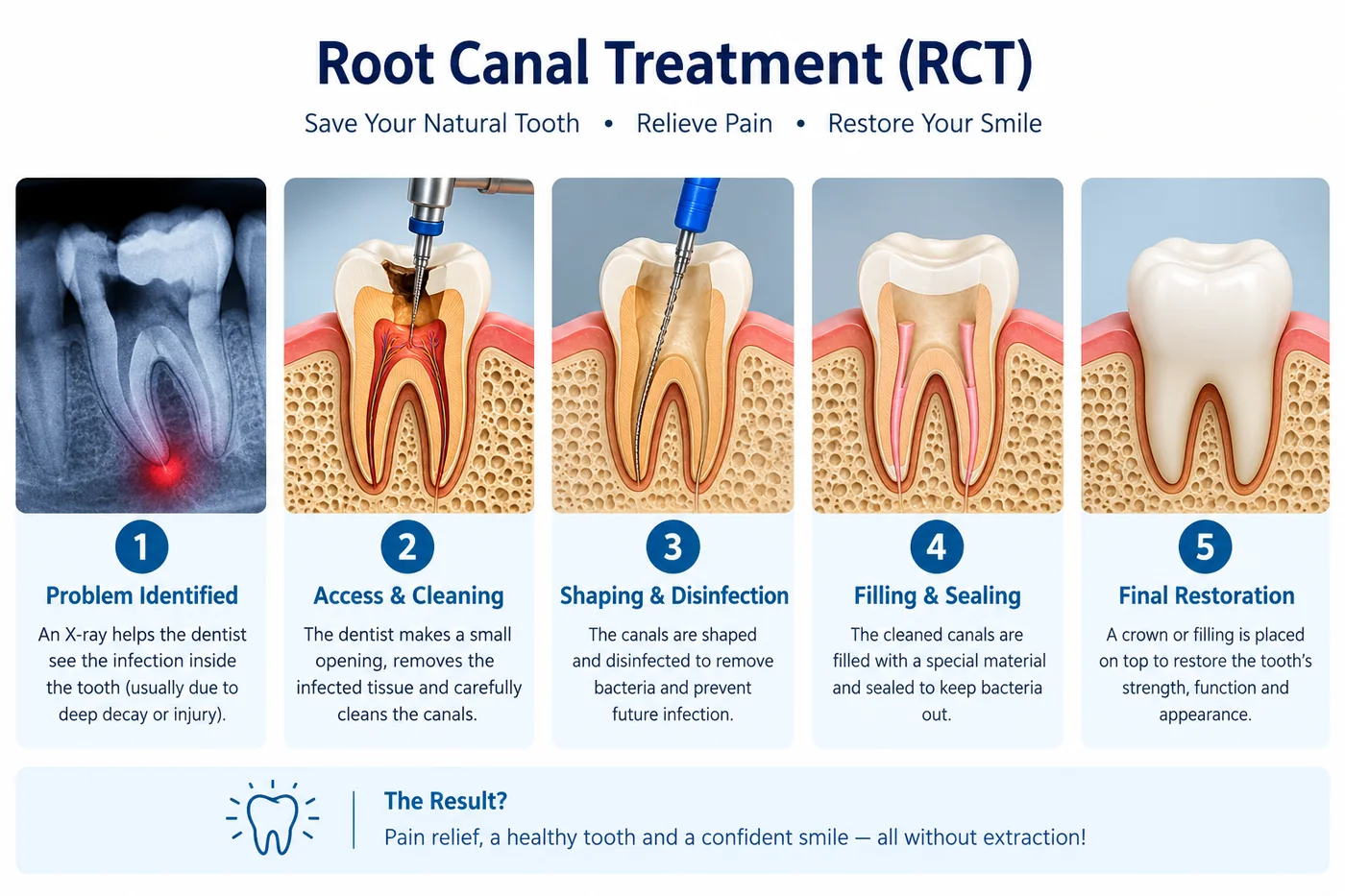
A root canal removes the infected or damaged pulp from the inside of the tooth, cleans the canals and seals them so bacteria cannot return. It sounds dramatic, but the steps are straightforward and are done in a calm, unhurried way.
- We examine the tooth and take an X-ray to confirm the diagnosis.
- The tooth is numbed with local anaesthesia, and we check that you are fully numb before we begin.
- A small opening is made, and the infected pulp is removed.
- The canals are cleaned, shaped and disinfected.
- The canals are filled and sealed, and the tooth is closed with a temporary or permanent filling.
- Most root canal treated teeth then need a crown to protect them.
Many teeth can be completed in one or two visits. The number depends on how many canals the tooth has, how severe the infection is and how the tooth responds. We tell you what to expect at the start of your appointment, and you can raise your hand at any point if you need a pause.
Is a Root Canal Painful? What to Expect Afterwards
The reputation for pain comes from the toothache that leads to a root canal, not from the treatment itself. With good local anaesthesia you should feel pressure and vibration but not sharp pain. If you do feel something, tell us and we will top up the numbing before continuing.
After the numbness wears off, the tooth may feel tender for a few days, especially when you bite. This is normal and usually settles with the pain relief your dentist advises. Avoid chewing hard food on that side until the tooth has its final crown or filling.
Call us if pain gets worse after the first few days, if swelling appears, or if your bite feels high. These are simple to fix when caught early. Patients who feel nervous about dental treatment may also like to read about our painless dentistry approach, which applies to root canals as much as to any other treatment.
Root Canal or Extraction: Which Is Better?
When a tooth can be restored, saving it is usually the better choice. Your natural tooth chews better than any replacement, keeps the bone in place and does not rely on neighbouring teeth. Extraction can leave a gap that lets teeth tilt and drift, and replacing the tooth later with an implant or bridge costs more time and money.
There are cases where extraction is the sensible option: a tooth that has cracked below the gum line, a tooth with too little healthy structure left to support a crown, or one with severe gum disease. We will explain honestly why we recommend one route over the other, and we will not push you toward the more expensive choice.
If a tooth cannot be saved, we will talk you through replacement options so that you are not left with a gap for long.
Why a Crown Is Often Needed After a Root Canal
A tooth that has had a root canal has lost its blood supply and a large part of its structure, because decay or a large filling removed the rest. It becomes more brittle and can crack under normal chewing, especially at the back of the mouth. A crown wraps around the tooth like a protective cap and spreads the chewing force.
For front teeth, the shade and shape of the crown matter as much as the strength. If a discoloured front tooth is bothering you, ask about options during your visit. Many patients combine this with whitening for the surrounding teeth, so the whole smile looks even. If you are searching for a smile makeover dentist near me, a plan that begins with a root canal and crown on one visible tooth is a common starting point, and our team can map the steps for you.
Root Canal Treated Teeth and Braces
A root canal does not rule out straightening. Teeth that have had root canal treatment can often be moved with braces, provided the tooth is healthy, well sealed and free of infection. A braces dentist in Greater Noida will review your X-rays first and may recommend a crown or a stronger filling before orthodontic force is applied.
If you plan to start braces treatment in Greater Noida soon and you have a tooth with a deep cavity or pain, deal with that tooth first. Infection can flare up during orthodontic treatment, and interrupting braces to fix an emergency is more stressful than fixing the tooth beforehand.
Mention any past root canal when you ask about clear aligners in Greater Noida too. The aligner plan can be built around the treated tooth, and we will tell you if a particular movement is risky for it. If you are looking for a dentist for braces near me who also treats root canals, we can look after both under one roof, so one clinic knows your full dental history. You can also read our orthodontic clinic in Greater Noida section to see what a complete orthodontic assessment includes, and our orthodontist near me guidance if you prefer to search by distance.
What Affects the Cost of a Root Canal
Two root canals can cost different amounts, because teeth are different. The main factors are which tooth is being treated (back teeth have more canals), how complex the canals are, how severe the infection is, whether the tooth needs to be rebuilt before a crown can be fitted, and what kind of crown you choose.
We do not quote a price over the phone, because without an examination it would be a guess. After we have seen and X-rayed the tooth, we give you a clear estimate that explains what is included. If you are comparing clinics, compare the same things: examination, X-ray, treatment visits, the filling and the crown. The same logic applies when you look for an affordable orthodontist near me or affordable braces in Greater Noida: a fair price is one that is clear and complete.
Aftercare and Long-Term Care
Once the root canal and crown are complete, the tooth needs the same care as any other: brushing twice a day, cleaning between the teeth and a check-up every six months. A treated tooth can still decay around the edges of the crown, so good hygiene matters.
Avoid biting very hard objects such as ice, pen caps or nutshells, because treated teeth are more fragile. If you grind your teeth at night, tell your dentist; a night guard can protect both the crown and your other teeth.
If anything feels wrong later, such as pain on biting, a loose crown or a gum bump, do not wait. Call or WhatsApp us, and we will see you promptly.
Questions Patients Ask About Root Canals
Patients often ask whether a root canal makes you ill. It does not. The treatment removes infection from the tooth, which is better for your general health than leaving it in place. Another common question is whether the tooth will die. The nerve inside is already damaged, and removing it leaves a tooth that is no longer sensitive to heat and cold but is still held firmly in the jaw by the bone and gum around it.
Another question is about repeat treatment. A small number of root canals need to be redone, usually because a canal was complex or bacteria returned through a leaking filling or crown. That is another reason a good final restoration matters. If you are searching for the best dentist for braces near me or an orthodontist near me and you have a root canal treated tooth, mention it at the first visit so that the plan includes it.
Choosing a Clinic Near You for Root Canal and Orthodontic Care
Root canal treatment is often the first step in a longer plan, so it helps to choose a clinic that can also look after what comes next. Many patients search for a dentist for braces near me, a braces specialist near me or an orthodontist near me at the same time as they ask about a painful tooth, because they want straighter teeth once the pain is dealt with. Others ask about clear aligners near me, invisible braces near me, a clear aligner dentist near me or a teeth alignment specialist near me, and want one clinic that knows their whole history.
If cost is a worry, read about an affordable orthodontist near me, affordable braces in Greater Noida and clear aligners cost in Greater Noida, and ask for the root canal, crown and any orthodontic treatment to be listed separately. To judge a clinic, our best dentist for braces near me, best orthodontist in Greater Noida and orthodontic clinic in Greater Noida guides list what to ask, and a teeth straightening dentist in Greater Noida or smile correction clinic in Greater Noida plan shows how treatments fit together. We welcome patients from across Greater Noida and nearby areas.
Root Canal Treatment for CGHS Patients, in an Accredited Hospital
Root canal treatment involves instruments that must be properly sterilised, so many patients look for a NABH accredited dental clinic in Greater Noida before they book. We follow written infection-control procedures for every root canal.
CGHS cardholders can ask about CGHS dental treatment in Greater Noida, including root canal treatment, at our hospital. As a CGHS empanelled dentist in Greater Noida, we explain what falls within the CGHS list and what documents are needed. See our CGHS page for age-wise rules.
When you may need root canal treatment
- Deep decay that has reached the nerve of the tooth
- Pain that lingers after hot or cold food and drinks
- Pain when you bite or chew
- Swelling of the gum or a small pimple-like bump near the tooth
- A cracked or broken tooth with an exposed nerve
- A single tooth that has darkened after an injury
What to expect
- Examination and X-rayWe examine the tooth and take an X-ray to confirm that a root canal is the right treatment.
- NumbingLocal anaesthesia is given so the tooth and the area around it are fully numb before we begin.
- Cleaning the canalsInfected pulp is removed, and the root canals are cleaned and shaped.
- Filling and sealingThe cleaned canals are filled and sealed to keep bacteria out.
- Crown or fillingMost root canal treated teeth need a crown or a strong filling to protect them from cracking.
Benefits
- Keeps your natural tooth in place
- Relieves pain caused by infection
- Stops infection from spreading to the jaw
- Lets you chew comfortably again
Questions about root canal treatment
Is root canal treatment painful?
The treatment is done under local anaesthesia, so you should not feel pain during the procedure. Mild tenderness for a few days afterwards is common and usually settles with the pain relief your dentist advises.
How many visits does a root canal take?
Many teeth can be completed in one or two visits. The number depends on how severe the infection is and how many canals the tooth has. We confirm this after your examination.
Do I need a crown after a root canal?
Often yes, especially for back teeth, because a root canal treated tooth is more likely to crack. Dr. Saxena will advise what suits your tooth.
Is it better to extract the tooth?
Saving your natural tooth is usually the better option when it can be restored. If a tooth cannot be saved, we will explain why and talk through replacement options.
This page gives general information. Every mouth is different, so the right treatment and timeline depend on your examination.