On this page
Tap a topic to jump to it.
- What Is a Dental Crown?
- What Is a Dental Bridge?
- Crown and Bridge Materials
- The Crown or Bridge Process
- Crowns vs Straightening: Choosing the Right Option
- Crowns in a Smile Makeover
- Looking After Crowns and Bridges
- Common Problems and How We Solve Them
- Questions About Crowns and Bridges
- Choosing a Clinic Near You
- Signs a Tooth May Need a Crown
- Alternatives to Crowns and Bridges
- Crowns, Bridges and Dentures for CGHS Patients
 Tap to enlarge
What Is a Dental Crown?
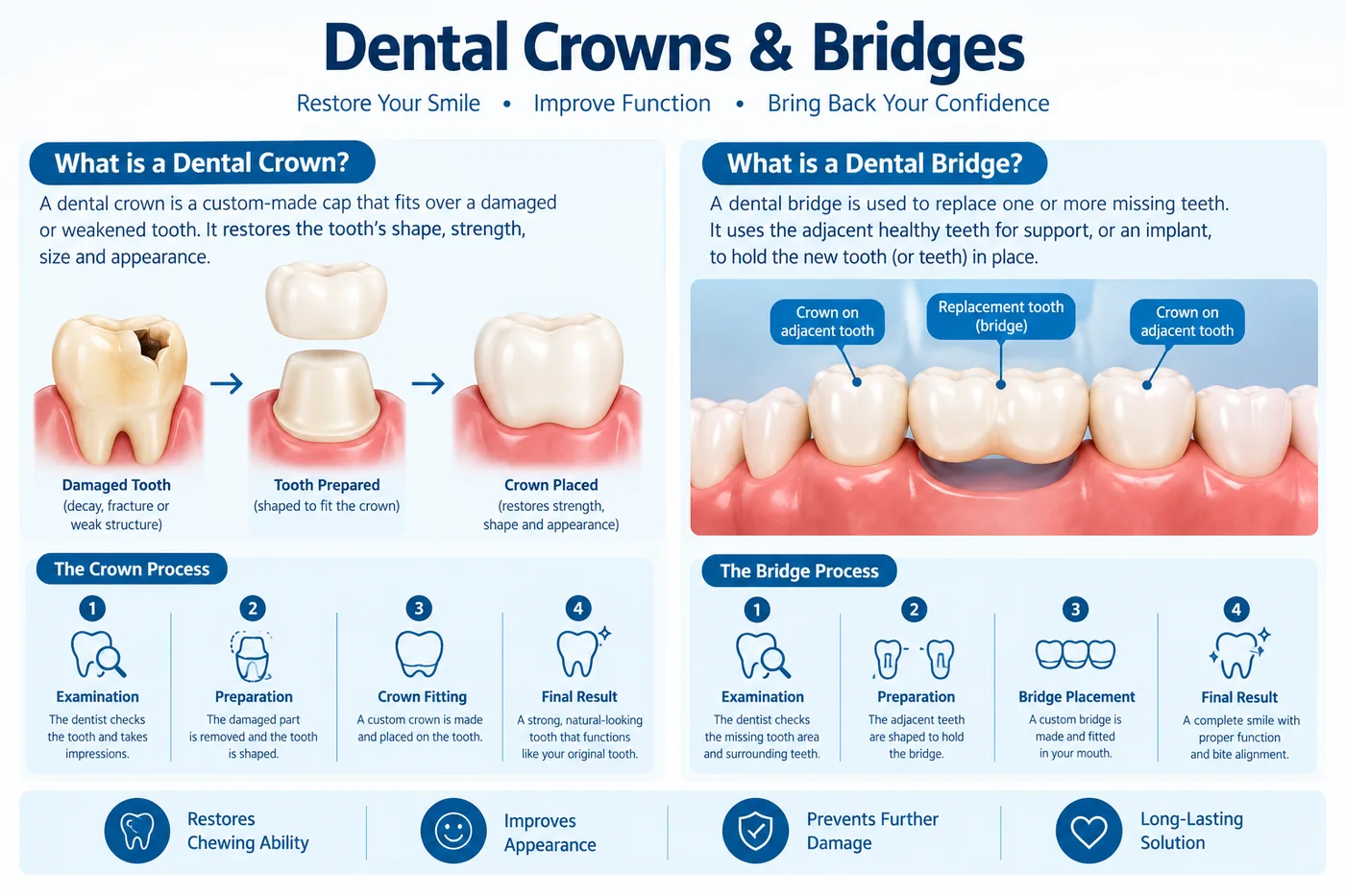
A crown, sometimes called a cap, is a tooth-shaped covering that fits over a damaged or weak tooth. It restores the tooth’s shape, size and strength, and it protects what remains of the natural tooth. We recommend crowns for teeth with large fillings, teeth that have had root canal treatment, cracked or worn teeth and teeth that are badly shaped or discoloured.
A well-made crown matches the colour of your other teeth and fits the bite so that chewing feels natural.
What Is a Dental Bridge?
A bridge replaces one or more missing teeth by joining an artificial tooth to crowns on the teeth either side of the gap. It is a fixed solution, which you cannot remove, and it restores your ability to chew and to speak clearly.
A bridge relies on the neighbouring teeth, which need to be reshaped to hold it. That is why we check that those teeth are healthy and strong enough. If they are not, we will talk about alternatives such as an implant.
Crown and Bridge Materials
Common choices include ceramic and zirconia crowns, which look the most natural, and porcelain fused to metal, which is strong and often more economical. Metal crowns are extremely durable and are sometimes used for back teeth where appearance matters less.
The best material depends on the position of the tooth, how hard you bite, whether you grind your teeth, the colour of neighbouring teeth and your budget. We explain the options and recommend one that suits your case.
The Crown or Bridge Process
- Examination: we check the tooth, the gums and your bite, and take X-rays.
- Preparation: the tooth is shaped under local anaesthesia, and an impression or scan is taken.
- Temporary crown: a temporary crown protects the tooth while the final one is made.
- Fitting: the final crown or bridge is checked for fit, bite and colour and then cemented.
- Aftercare: regular cleaning around the crown keeps the gums healthy.
Most crowns need two visits. We explain the timeline at your first appointment.
Crowns vs Straightening: Choosing the Right Option
A crown is not always the best way to change the look of a crooked tooth. Cutting down a healthy tooth to fit a crown is a bigger step than moving it into place. When the problem is alignment, straightening with braces or aligners can protect your natural teeth. Your dentist will explain when a crown is the right choice and when straightening is.
That is why a smile correction clinic in Greater Noida looks at the whole picture. A gap from a missing tooth may need a bridge or implant, crooked teeth may need braces treatment in Greater Noida or clear aligners in Greater Noida, and worn or discoloured teeth may need crowns or whitening.
A teeth straightening dentist in Greater Noida can show you how aligners and braces compare, and our page on invisible braces in Greater Noida explains the discreet options. A braces dentist in Greater Noida will tell you honestly whether straightening or a crown gives the better long-term result for your tooth.
Crowns in a Smile Makeover
Crowns are often one step within a bigger plan. Searching for a smile makeover dentist near me? Ask for a plan that puts treatments in the right order: gum health first, then alignment, then whitening, then crowns or veneers where needed, so that each step supports the next.
If you are comparing clinics, an orthodontist near me or a best dentist for braces near me who explains the sequence clearly is more likely to give you a result that lasts than one who offers a quick fix. Our orthodontic clinic in Greater Noida guide describes what an orthodontic assessment involves, and an affordable orthodontist near me should be clear about the cost of each stage.
Looking After Crowns and Bridges
Brush twice a day and clean around the crown or under the bridge with floss threaders or interdental brushes. Plaque at the edge of a crown can cause decay in the tooth underneath, so careful cleaning matters.
Avoid biting very hard objects, and tell us if you grind your teeth. If a crown feels loose, comes off, or the bite feels high, call us. A crown that is replaced early can usually be saved, while a neglected one may lead to decay or fracture of the tooth underneath.
Common Problems and How We Solve Them
Crowns can become loose, chipped or sensitive, and the tooth underneath can decay at the edge. A loose crown should be re-cemented quickly, ideally within a day or two, before the tooth is damaged. If a crown chips, we may be able to polish or repair it. Sensitivity after a new crown usually settles within a few weeks.
A bridge can loosen if one of the supporting teeth decays or the cement fails. Gum disease around a bridge can be hard to clean, which is why we show you how to clean under it. We see you for regular checks so that small problems do not become large ones.
Questions About Crowns and Bridges
Will a crown hurt? The tooth is numbed, and you feel pressure but not pain. How long does a crown last? It depends on your care, your bite and the material, and many last for years. Can I have a crown on a front tooth? Yes, and we match the shade carefully. Do I have to have the tooth cut down? Usually, some tooth is removed to make room for the crown, but we keep this to the minimum.
Can I have whitening after a crown? Whitening does not change the colour of crowns, so we plan whitening first and match the crown to the shade you like.
Choosing a Clinic Near You
Look for a clinic that explains the choice of material, shows you the shade options and fits the crown carefully. A dentist for braces near me who also does restorative work can plan your whole treatment. Patients ask us about a braces specialist near me, an orthodontist near me, clear aligners near me, invisible braces near me, a clear aligner dentist near me and a teeth alignment specialist near me, and our guides explain how to choose each. If cost is key, read about an affordable orthodontist near me, affordable braces in Greater Noida and clear aligners cost in Greater Noida, and see how the best dentist for braces near me and best orthodontist in Greater Noida guidance can help you compare. We welcome patients from across Greater Noida and nearby areas.
Signs a Tooth May Need a Crown
- A large filling that takes up much of the tooth.
- A crack that causes pain on biting or release.
- A tooth that has had a root canal.
- A worn-down tooth from grinding or acid.
- A tooth that is badly discoloured or misshapen.
- A tooth that is the support for a bridge or a denture clasp.
If you notice any of these, a check-up and X-ray will show whether a crown is the best option. Protecting a weakened tooth early often saves it from breaking.
Alternatives to Crowns and Bridges
Not every damaged tooth needs a crown. Small and medium cavities can be restored with fillings. A chipped front tooth may be repaired with bonding. For some tooth gaps, an implant avoids touching the neighbouring teeth, and a partial denture is a removable option. For crooked teeth, straightening may protect the natural tooth structure.
We explain each alternative and what it can and cannot do, so you can choose with all the information. For orthodontic alternatives, see braces treatment in Greater Noida and clear aligners in Greater Noida.
Crowns, Bridges and Dentures for CGHS Patients
Many senior patients need crowns, bridges or dentures. CGHS dental treatment in Greater Noida can include such work at approved rates, and the details depend on the scheme. As a CGHS empanelled dental hospital in Greater Noida, we tell you what is covered before treatment.
Because crowns and bridges involve preparing teeth and taking impressions, hygiene matters, and our written infection-control procedures apply to every patient. See our NABH page.
When you may need dental crowns & bridges
- A tooth weakened by a large filling or decay
- A tooth treated with a root canal
- A cracked or worn tooth
- A discoloured or misshapen tooth
- A gap from one or more missing teeth
What to expect
- ExaminationWe check the tooth, the gums and your bite, and recommend the right restoration.
- Preparing the toothThe tooth is shaped under local anaesthesia, and an impression or scan is taken.
- Temporary crownA temporary crown protects the tooth while your final restoration is made.
- FittingThe final crown or bridge is checked for fit, bite and colour, and then cemented.
Benefits
- Restores strength and chewing comfort
- Natural-looking shade and shape
- Protects a weak tooth from breaking
- Fills gaps without a removable denture
Questions about dental crowns & bridges
What are crowns made of?
Common options include ceramic and zirconia, and porcelain fused to metal. We recommend a material based on the tooth’s position, your bite and your budget.
How long does a crown last?
With good oral hygiene and regular check-ups, crowns can last many years. Habits such as grinding or chewing hard objects can shorten their life.
How is a bridge different from an implant?
A bridge uses the neighbouring teeth for support and is faster. An implant replaces the root and stands on its own. We help you compare the two.
Will the crown look natural?
Yes. We match the shade and shape to your surrounding teeth.
This page gives general information. Every mouth is different, so the right treatment and timeline depend on your examination.