
On this page
Tap a topic to jump to it.
- What Is a Dental Implant?
- Who Is Suitable for an Implant?
- The Implant Journey: From Consultation to Final Crown
- Implants, Bridges and Dentures Compared
- Moving Teeth Before an Implant: Braces and Clear Aligners
- Implants as Part of a Smile Makeover
- Caring for Your Implant
- Risks, Success and What We Check First
- How Long Does Implant Treatment Take?
- Finding the Right Clinic for Implants and Smile Work
- Questions About Implants
- Dental Implants in a NABH Accredited Setting
 Tap to enlarge
What Is a Dental Implant?
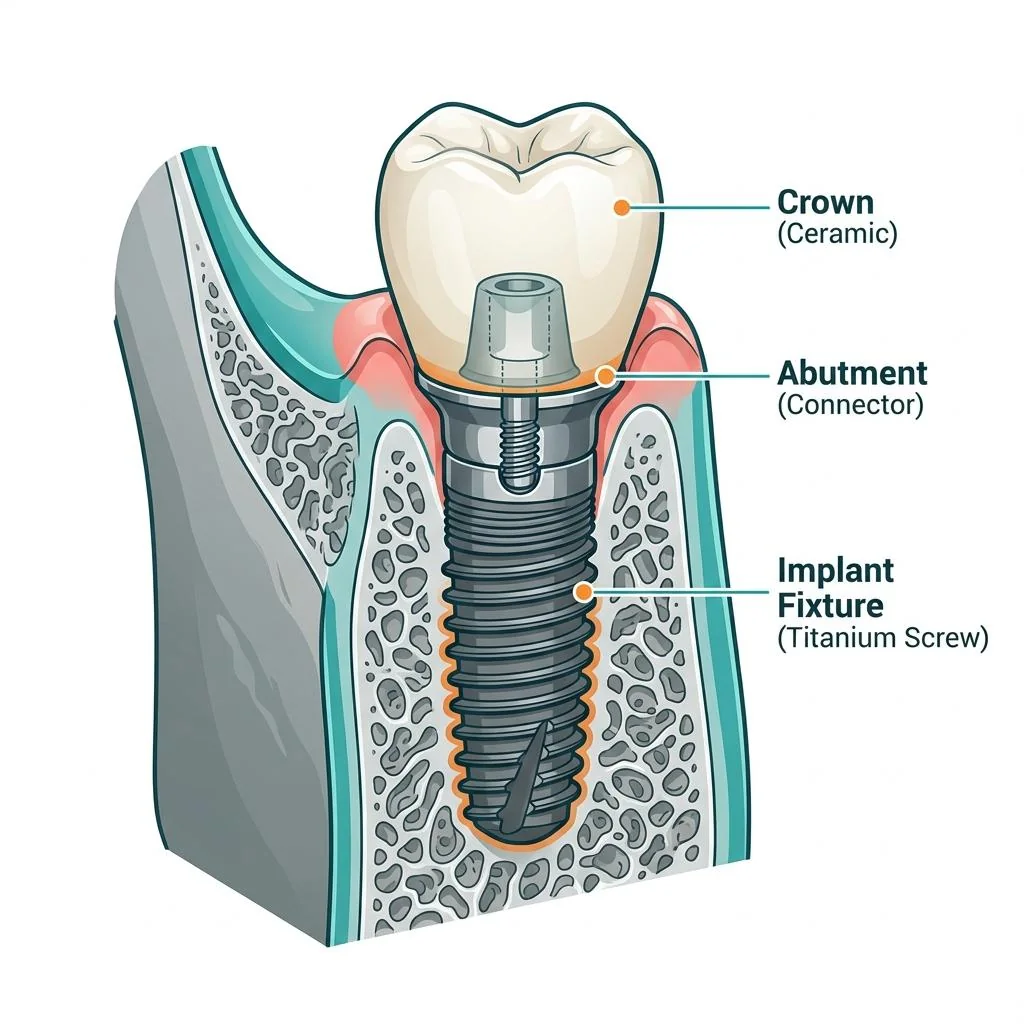
A dental implant is a small titanium post that replaces the root of a missing tooth. After it is placed in the jawbone, the bone grows around it over a few months and holds it firmly. A connector and a custom-made crown are then fitted on top, so the replacement looks, feels and works like a natural tooth.
Because the implant sits in the bone, it does not rely on the neighbouring teeth for support. This is the biggest difference from a traditional bridge, which needs the teeth on either side to be shaped to hold it. An implant can also help keep the jawbone in the area where the tooth was lost, which a bridge or denture does not do in the same way.
Who Is Suitable for an Implant?
Most healthy adults with enough jawbone and healthy gums can be considered. Smoking, uncontrolled diabetes and untreated gum disease slow healing and raise the risk of failure, so we assess these before planning treatment.
If you have lost bone after a tooth was missing for many years, an implant may still be possible, sometimes with an additional procedure to build the bone. We will explain whether that applies to you after looking at your X-rays. We will also tell you when an implant is not the best option and what to choose instead.
The Implant Journey: From Consultation to Final Crown
- Consultation and scans: we examine your gums, bite and bone, take X-rays and discuss what you want.
- Treatment planning: we decide where each implant will go and whether any preparation is needed first, such as treating gum disease.
- Implant placement: the titanium post is placed under local anaesthesia.
- Healing: the implant fuses with the bone over a few months, and we review you along the way.
- Abutment and crown: a connector and a custom crown are fitted and matched to the shade and shape of your teeth.
- Aftercare: regular cleaning and check-ups keep the gums and bone around the implant healthy.
The total time depends on your bone and how quickly you heal. We explain the timeline during your consultation, so you can plan around it.
Implants, Bridges and Dentures Compared
Each option has a place. A bridge is quicker and avoids surgery, but it needs the neighbouring teeth to be reshaped. A removable denture is usually the most economical, but it can feel less stable. An implant takes longer, leaves the neighbouring teeth untouched and feels the most natural.
The right choice depends on your gums, bone, the teeth next to the gap, your general health and your budget. Our blog article on implants and bridges goes through the trade-offs in more detail. Whichever route you choose, we plan it so it fits with the rest of your treatment.
Moving Teeth Before an Implant: Braces and Clear Aligners
Sometimes teeth need to be moved before an implant can be placed. If the neighbouring teeth have tilted into a gap over the years, there may not be enough space for a new tooth, and the bite may be off. Straightening them with braces or clear aligners in Greater Noida can open up the right space and align the teeth so the implant crown sits correctly.
A teeth straightening dentist in Greater Noida and an implant plan working together give a more balanced, longer-lasting result than either on its own. If you would prefer straightening that is not obvious, ask about invisible braces in Greater Noida. Our guide to braces treatment in Greater Noida explains how orthodontic treatment is planned, and a braces dentist in Greater Noida can tell you whether your case needs it before implant work.
Searching for the best orthodontist in Greater Noida or an orthodontist near me for a case like this? Look for a clinic that discusses the whole sequence with you, not just one step.
Implants as Part of a Smile Makeover
For many patients, an implant is one piece of a larger plan. The shade of the surrounding teeth, the alignment of the bite, the health of the gums and the shape of the smile all affect how the final crown looks.
A smile correction clinic in Greater Noida plan puts these pieces in order. Gums are treated first, teeth are aligned if needed, the implant is placed and healed, and the crown is made to match the final shade. If you are looking for a smile makeover dentist near me, start with a consultation where we map out the order of treatments and explain what is realistic for your teeth.
Caring for Your Implant
Implants cannot decay, but the gums around them can become inflamed if plaque builds up. Brush twice a day, clean between the teeth and the implant with floss or small interdental brushes, and keep up with professional cleaning.
Tell us if you smoke, because smoking affects healing and long-term success. Avoid chewing very hard objects, and tell your dentist if you grind your teeth at night. If an implant crown ever feels loose, or the gum around it bleeds or swells, call us early.
Risks, Success and What We Check First
Implants have a high success rate in healthy patients, but like any treatment they carry risks. Infection, slow healing, an implant that does not fuse with the bone and inflammation around the implant can happen. Smoking, poorly controlled diabetes and gum disease raise the risk, which is why we assess them before planning.
Before we recommend an implant, we look at the amount and quality of the bone, the health of the gums, your bite and your general health. We explain the risks in plain language and what we do to reduce them. If an implant is not suitable, we tell you and discuss other options. Honest assessment protects you from treatment that is unlikely to succeed.
How Long Does Implant Treatment Take?
Timelines vary. A straightforward case takes several months from placement to the final crown, because the bone needs time to fuse with the implant. If a tooth must be removed first or the bone needs building up, the process is longer. Gum disease or braces needed beforehand add to the time.
We give you a timeline at the consultation, with the main milestones. You will usually have a handful of visits: planning, placement, one or more reviews, and the final crown fitting. We keep in touch between visits, and you can call us if anything feels wrong during healing.
Finding the Right Clinic for Implants and Smile Work
Implants are a long-term investment, so the clinic matters. Look for one that examines you thoroughly, uses X-rays to plan, explains each stage and gives you an estimate in writing. Ask who will do the work, what happens if the implant does not fuse and how long you will be followed up.
If you are also thinking about straightening, a clinic that offers both is convenient. A dentist for braces near me who also plans implants can coordinate the two. Many patients search for a braces specialist near me, a best dentist for braces near me or an affordable orthodontist near me at the same time as thinking about implants, and our guides explain how to compare clinics for each. If you want to see how orthodontic treatment fits with restorative work, read about an orthodontic clinic in Greater Noida and a teeth straightening dentist in Greater Noida.
Questions About Implants
Will people notice? A well-made implant crown looks and feels like a natural tooth. Can I have several teeth replaced? Yes, with a few implants supporting a bridge or several crowns, depending on your case. Can I have an implant straight after an extraction? Sometimes, if the bone and gums are healthy and there is no infection, but not always.
Can I have an MRI or airport scan? Titanium implants do not normally cause problems with these. How do I clean it? As you would your own teeth, with extra care at the gum line.
Dental Implants in a NABH Accredited Setting
An implant is minor surgery, so the safety of the setting matters. Patients looking for a NABH accredited dentist in Greater Noida or a NABH accredited hospital in Greater Noida for implants want clear consent, sterile instruments and good records, which is what accreditation standards ask for.
If you hold a CGHS card, speak to us about implants before you decide. Whether an implant is payable under the scheme depends on CGHS rules, and as a CGHS dental clinic in Greater Noida we tell you honestly. Read our CGHS page for more.
When you may need dental implants
- One missing tooth, or several
- Loose or uncomfortable dentures
- A tooth that cannot be saved and needs replacing
- A wish for a fixed solution instead of a removable one
- Bone loss after a tooth was lost some time ago, which needs assessment first
What to expect
- Consultation and scansWe check your gums, bite and bone with X-rays, and tell you if implants suit you.
- Implant placementThe titanium post is placed in the jaw under local anaesthesia.
- HealingThe implant fuses with the bone over a few months. We review your healing along the way.
- Abutment and crownA connector and a custom-made crown are fitted, matched to the shade and shape of your teeth.
- AftercareRegular cleaning and check-ups keep the gums and bone around the implant healthy.
Benefits
- Fixed teeth that do not slip or click
- Natural look and feel
- Neighbouring teeth stay untouched
- Helps maintain the bone where the tooth was lost
Questions about dental implants
Am I suitable for a dental implant?
Most healthy adults with enough jawbone and healthy gums can be considered. Smoking, uncontrolled diabetes and gum disease affect healing, so we assess these before we plan treatment.
Is the implant procedure painful?
Placement is done under local anaesthesia. Some soreness and swelling afterwards is normal and is managed with the medication we prescribe.
How long does the whole process take?
It usually takes a few months from placement to the final crown, because the implant needs time to fuse with the bone. Your timeline depends on your bone and healing.
Implant or bridge: which is better?
An implant does not need the neighbouring teeth to be shaped, while a bridge is quicker. We explain both and help you choose. Our blog compares them in detail.
This page gives general information. Every mouth is different, so the right treatment and timeline depend on your examination.